


Page 7 - PDPOINTER092021
P. 7
PD Pointer Volume 63                                                                                                                              Page 7


         A teacher retirement                                                                                    By Martin Gustafsson
                                                                                                                 Education economist, Stellenbosch
                                                                                                                 University

         wave is about to hit SA                                                                                 He  works for Stellenbosch Univer-
                                                                                                                 sity and the South African Govern-
                                                                                                                 ment. He has moreover done work
                                                                                                                 for the UNESCO Institute for Sta-
                                                                                                                 tistics. He receives funding from the National Re-
                                                                                                                 search Foundation, through his work with Research on
                                                                                                                 Socio-Economic Policy (ReSEP), based at the Univer-
         It could have a major impact on class size                                                              sity of Stellenbosch.

                                                                                                                 Tsekere Maponya, Deputy Director at the Department
         T                                                   This article is republished from The Conversa-      Planning, Provisioning and Monitoring unit, also con-
                                                                                                                 of Basic Education’s Education Human Resource
                eacher supply and demand is a complex mat-
                ter. The ultimate aim is to have a teacher in
                                                             tion under a Creative Commons license.
                                                                                                                 tributed to this article.
                front of every class, now and for the foreseea-
                ble future. This also implies an ideal class
         size. The quality of teachers is obviously important too
         – and a topic for another occasion.
         In South Africa, the ideal class size is tacit, and not   ods for teachers, and too few classes being taught at   South Africa’s teachers enjoy the standard of living of
         explicit, as there are no class size norms. Instead, it is   any time. This is especially the case beyond Grade 3,   teachers in a country like Denmark.
         the available budget and negotiated teacher pay     where it becomes increasingly common for teachers   We conclude that evidence of sky-high pay among
         which drive the number of teachers, which in turn   to specialise in a curriculum subject.              South Africa’s teachers is flawed. It is not just a prob-
         largely determines the average class size. But there   Fourthly, schools permitted to charge fees, which tend   lem with South Africa’s figures: Nigeria’s teachers are
         are other factors at play too, as we’ll explain.    to be middle class schools, can employ additional   said to be better paid that those in several European
         If South Africa were to lower the pupil-teacher ratio   teachers and thus reduce class sizes.           Union countries.
         from the current 30 to a typical middle income country   The province a school is in plays a remarkably large   We argue that existing international comparisons of
         level of around 25, it would need an additional     role. Schools with similar learner-educator ratios end   teacher pay suffer from two serious problems. First,
         100,000 teachers. Government spending on school-    up with very different class sizes, depending on prov-  how pay is defined, for instance with regard to bene-
         ing is already fairly high, so it would be difficult to pay   ince.                                     fits and income tax, is frequently unclear, which raises
         that many more teachers.                            The following graph shows that in primary schools   comparability questions. Perhaps more seriously, pur-
         Is the problem that teachers in South Africa are paid   with an educator for every 32 learners, as an exam-  chasing power parity indices are less reliable than
         too much? We conducted an international comparison,   ple, the percentage of the school’s learners in a class   what is often believed. We deal with these problems
         using household assets to stand in for purchasing   exceeding 40 learners differs vastly. In Free State and   by using household assets to provide what we believe
         power. We found that South African teachers’ pur-   Gauteng, this figure is around 30% of learners. In oth-  is a more comparable indicator of purchasing power.
         chasing power was not that different from that of                                                       Our conclusion that the pay of South Africa’s teachers
         teachers in other middle income countries.                                                              is in fact not abnormally high substantially weakens
         There is a window of opportunity which has received                                                     the argument that reducing class sizes by paying
         insufficient attention. Soon there will be a large wave                                                 teachers less, and employing more of them, is a via-
         of retirements among South African teachers, peaking                                                    ble or justifiable option.
         around 2030 and ending in 2040. New, younger – and
         lower paid – teachers will have to take their place. But                                                Teacher retirement wave
         this opportunity comes with questions around the ca-
         pacity of universities to rapidly increase the output of                                                It is very clear from the current age structure of the
         teacher graduates.                                                                                      teacher workforce that there will be a large wave of
                                                                                                                 retirements until 2040. The expected surge in the in-
         Factors influencing class size                                                                          flow of younger teachers, who begin their careers at
                                                                                                                 entry level salaries, will be large enough to reduce
         Around half of South Africa’s primary learners are in                                                   average teacher pay in real terms by as much as
         classes with more than 40 learners. About 15% are in                                                    15%, according to one estimate, over a period of just
         classes exceeding 50 learners. The averages and ine-                                                    over ten years.
         quality are considerably worse than what one sees in                                                    The demographic dividend will not be large enough to
         countries such as Chile, Indonesia, Morocco and Iran.                                                   increase the teacher workforce by the 100,000 men-
                                                                                                                 tioned above, yet with careful planning, and careful
         What explains the inequality?                                                                           negotiation between the employer and unions, one
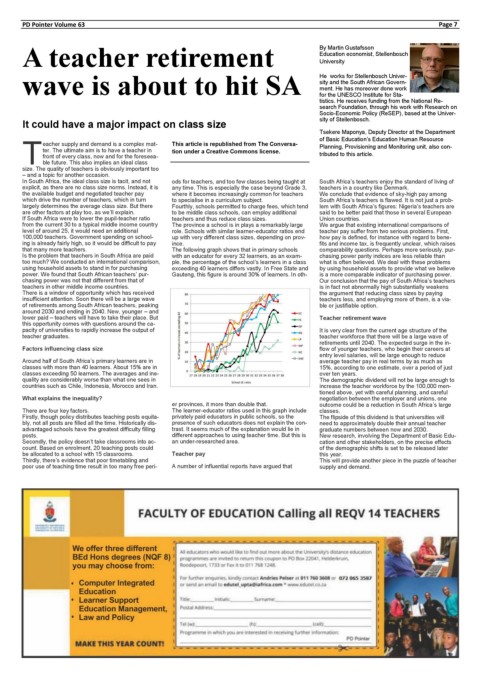
                                                             er provinces, it more than double that.             outcome could be a reduction in South Africa’s large
         There are four key factors.                         The learner-educator ratios used in this graph include   classes.
         Firstly, though policy distributes teaching posts equita-  privately paid educators in public schools, so the   The flipside of this dividend is that universities will
         bly, not all posts are filled all the time. Historically dis-  presence of such educators does not explain the con-  need to approximately double their annual teacher
         advantaged schools have the greatest difficulty filling   trast. It seems much of the explanation would lie in   graduate numbers between now and 2030.
         posts.                                              different approaches to using teacher time. But this is   New research, involving the Department of Basic Edu-
         Secondly, the policy doesn’t take classrooms into ac-  an under-researched area.                        cation and other stakeholders, on the precise effects
         count. Based on enrolment, 20 teaching posts could                                                      of the demographic shifts is set to be released later
         be allocated to a school with 15 classrooms.        Teacher pay                                         this year.
         Thirdly, there’s evidence that poor timetabling and                                                     This will provide another piece in the puzzle of teacher
         poor use of teaching time result in too many free peri-  A number of influential reports have argued that   supply and demand.

